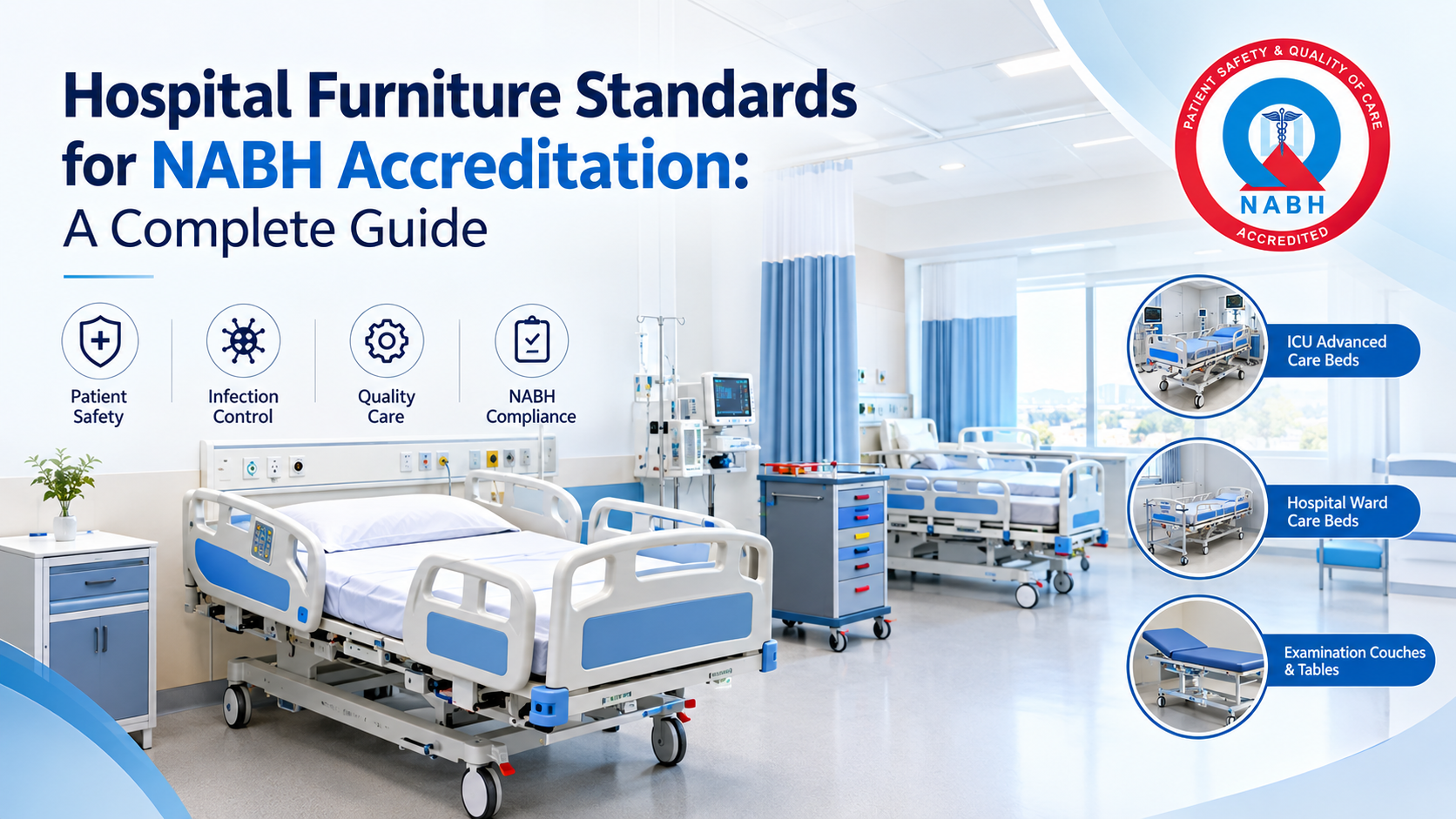
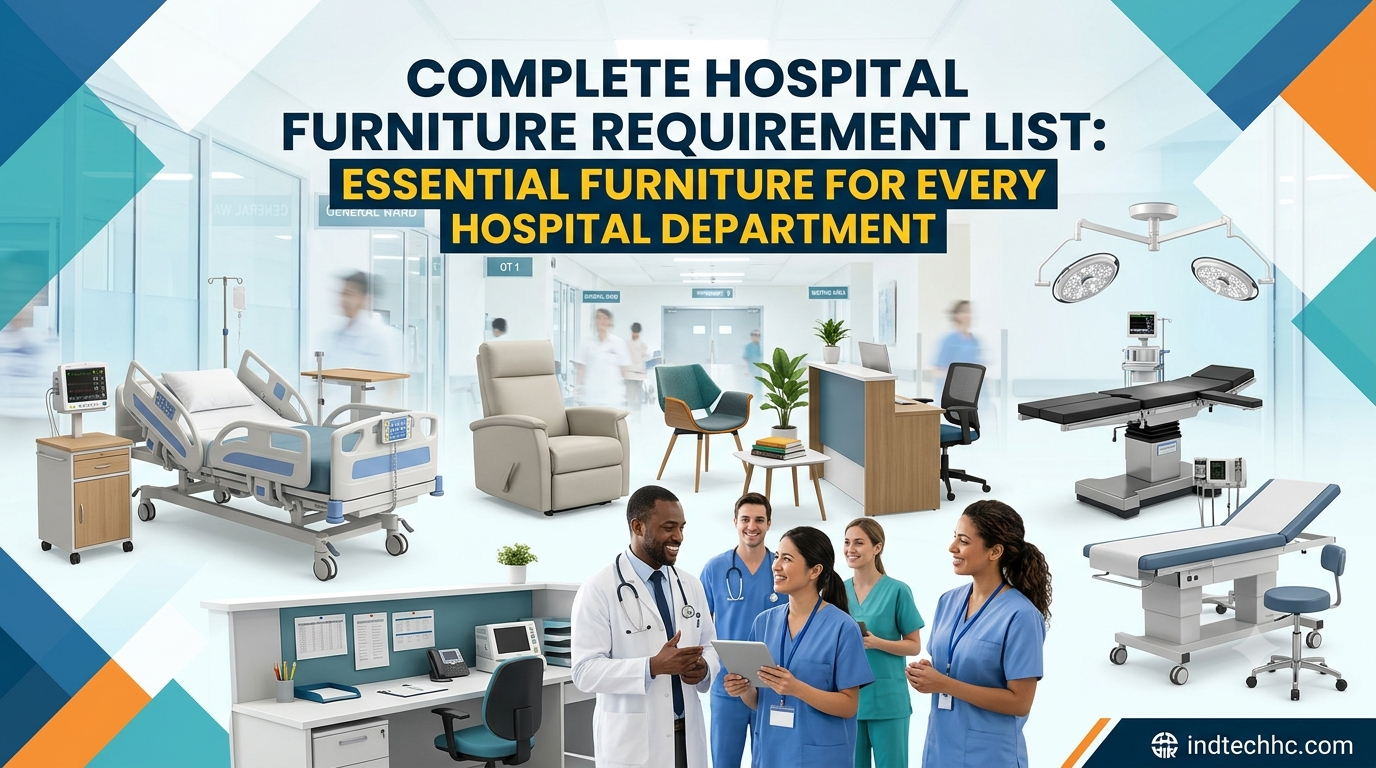
NABH accreditation is an important milestone for hospitals committed to improving patient safety, healthcare quality and operational efficiency. Preparing for accreditation requires hospitals to review their clinical procedures, infection prevention practices, infrastructure, equipment and documentation. Hospital furniture is an essential part of this process because it directly affects patient comfort, staff safety, hygiene and the delivery of care.
From intensive care units and general wards to examination rooms and patient transfer areas, every department needs furniture that is suitable for its intended purpose and maintained in safe working condition. Inappropriate bed designs, damaged surfaces, faulty brakes or inadequate maintenance procedures can create avoidable risks and operational challenges.
The National Accreditation Board for Hospitals & Healthcare Providers (NABH), a constituent board of the Quality Council of India, establishes accreditation standards focused on patient safety and quality of healthcare delivery. Its hospital standards address areas including patient care, hospital infection control, patient safety, facilities management and safety. Hospitals should refer to the applicable official standards when planning their accreditation activities.
In this guide, we explore the key hospital furniture considerations for NABH accreditation, how hospitals can assess furniture quality, and what to consider when selecting a reliable hospital furniture supplier.
1. Understanding Hospital Furniture Standards for NABH Accreditation
Hospital furniture standards should be understood in the context of the hospital's overall quality and safety management system. NABH accreditation is awarded to healthcare organisations based on their performance against applicable standards; it should not be interpreted as a separate certification of every bed, trolley or furniture product.
Furniture must be appropriate for the clinical activity being performed, safe for patients and staff, and maintained according to relevant instructions and hospital procedures.
For example, a hospital bed should provide suitable patient support and stable positioning. A transfer trolley should enable safe movement between departments, while an examination couch should be appropriate for the procedures performed in the room.
Hospitals should also establish procedures for cleaning, inspection, maintenance and defect reporting. These processes help ensure that furniture continues to support safe patient care throughout its service life.
When preparing for accreditation, administrators and quality managers should assess furniture alongside the applicable requirements for patient safety, infection prevention, equipment management and facilities maintenance.
2. Essential Safety Features in Hospital Furniture
Patient safety is a central consideration when selecting and maintaining hospital furniture. Procurement teams should evaluate products according to their intended use, expected workload and the needs of the patients who will use them.
Structural stability and load capacity
Beds, examination couches and transfer trolleys should have a stable construction and an appropriate load capacity. Frames, joints and supporting components should be inspected for damage, looseness, corrosion or deformation.
Furniture should be suitable for the expected frequency of use and the clinical environment in which it will operate.
Side rails and patient protection
Where hospital beds include side rails, the design and operation should be appropriate for the bed and the patient's individual needs. Staff should understand safe rail use and assess potential risks, including falls and entrapment.
Side rails alone do not eliminate fall risks. They must be used as part of an appropriate patient safety plan.
Brakes, castors and locking mechanisms
Beds and mobile trolleys must remain stable when stationary and move safely when required. Procurement teams should check brake operation, wheel condition, locking mechanisms and manoeuvrability.
Defective brakes or damaged castors should be reported promptly and addressed before the equipment is returned to service.
Adjustment mechanisms
Adjustable beds and examination furniture should operate reliably. Manual controls, electric actuators and moving components should be checked according to manufacturer instructions and the hospital's maintenance schedule.
Staff should be trained to operate specialised furniture safely and recognise when equipment requires attention.
3. ICU Advanced Care Beds: Requirements for Critical Care
Intensive care units provide treatment for patients who require close monitoring and specialised clinical support. The furniture used in these environments must accommodate patient positioning, nursing procedures, equipment access and emergency response.
When evaluating ICU beds, hospitals should consider the following features.
Adjustable positioning: Backrest, knee-rest and height adjustment can support appropriate patient positioning and routine nursing activities. The required functions depend on the ICU's clinical needs.
Emergency positioning: Where required, CPR-release or other emergency functions should be accessible, functional and familiar to clinical staff.
Patient safety features: Side rails, suitable mattress platforms and stable frames should be evaluated for safe use with the intended patient population.
Mobility and braking: Reliable brakes and appropriate castors help maintain stability during care and facilitate controlled movement when necessary.
Cleanability: Accessible frame surfaces and mattress platforms should support the hospital's cleaning and disinfection procedures.
Maintenance support: Powered beds require appropriate inspection and servicing in accordance with manufacturer recommendations.
Hospitals planning to upgrade their critical care facilities can explore ICU Advanced Care Beds from Indtech Healthcare. Reviewing the available specifications can help procurement teams identify suitable options for their clinical requirements.
The final selection should be based on the hospital's patient profile, equipment specifications, staff training needs and applicable safety requirements. The presence of particular features does not, by itself, establish NABH compliance.
4. Hospital Ward Care Beds: Comfort, Stability and Functionality
General wards accommodate patients with different medical conditions, mobility levels and recovery needs. Hospital ward care beds should provide appropriate support while allowing nurses and caregivers to perform routine activities efficiently.
Important considerations include:
Strong bed frames: Frames and mattress platforms should support the intended patient load and routine clinical use.
Adjustable backrests: Fowler and semi-Fowler configurations may be appropriate for patients who require different resting or treatment positions.
Safe side rails: Where provided, rails should be suitable for the bed design and used according to patient risk assessments.
Reliable brakes: Wheels and locking systems should function correctly to reduce the risk of unintended movement.
Cleanable surfaces: Frames and mattress covers should support effective cleaning and disinfection.
Caregiver access: Bed controls and adjustment mechanisms should be practical for everyday nursing activities.
Hospitals should also consider whether manual or motorised beds are more appropriate for their wards. This decision may depend on patient needs, staff workload, budget and available infrastructure.
Indtech Healthcare offers Hospital Ward Care Beds for hospitals reviewing their ward furniture requirements. Comparing product configurations and specifications can help facilities select beds suited to their operational needs.
Regular inspections are equally important. Damaged frames, worn mattress covers, faulty controls and unreliable brakes should be identified and addressed through the hospital's established maintenance procedures.
5. Infection Control and Hospital Furniture Materials
Infection prevention is a major part of hospital quality management. Furniture can support infection control when it is designed for the intended environment, remains in good condition and can be cleaned effectively.
Hospitals should consider several factors when choosing furniture.
Surface materials and finishes
Furniture surfaces should be appropriate for the clinical environment and compatible with the cleaning agents used by the hospital. Smooth, intact surfaces are generally easier to clean than damaged or deteriorated finishes.
Procurement teams should inspect upholstery, joints and frame components for cracks, peeling coatings or other areas where dirt and moisture may accumulate.
Mattress covers and upholstery
Mattress covers and upholstered surfaces should be appropriate for their intended clinical use and maintained in good condition. Tears, cracks or damaged seams can interfere with effective cleaning and should be addressed promptly.
Compatibility with cleaning products
Hospitals should confirm that furniture materials can withstand the cleaning and disinfection products specified in their procedures. Not every chemical is suitable for every surface, coating or upholstery material.
Cleaning schedules and responsibilities
Hospitals should establish appropriate cleaning procedures and assign responsibilities to relevant staff. Cleaning frequency and methods should reflect the clinical area, equipment use and applicable infection prevention policies.
Furniture that cannot be cleaned effectively or has deteriorated beyond safe use should be evaluated for repair or replacement.
6. Documentation, Inspection and Furniture Maintenance
Selecting appropriate furniture is only one part of equipment management. Hospitals must also maintain suitable processes to ensure that furniture remains safe and functional throughout its service life.
Before an accreditation assessment, hospitals should review the records relevant to their equipment management policies.
| Record or document | Purpose |
|---|
| Equipment inventory | Identifies furniture and its location |
| Purchase records and specifications | Supports product traceability |
| Manufacturer manuals | Provides operating, cleaning and maintenance instructions |
| Inspection records | Documents scheduled checks and identified defects |
| Maintenance and repair logs | Tracks servicing and corrective actions |
| Cleaning procedures | Defines cleaning methods and responsibilities |
| Staff training records, where applicable | Documents training for safe equipment operation |
| Fault and incident reports | Supports investigation and risk reduction |
The records required will depend on the equipment, applicable standards and the hospital's policies. Hospitals should ensure that documentation accurately reflects the equipment actually in use.
Inspection and maintenance schedules should be based on manufacturer recommendations, risk, usage and the hospital's procedures. When a bed has a defective brake or a trolley has damaged wheels, the issue should be reported and appropriate action taken before unsafe equipment is used again.
Maintaining accurate records also helps administrators identify recurring faults, plan replacements and make informed procurement decisions.
7. Common Furniture Problems Hospitals Should Identify
Internal audits can help hospitals identify potential furniture-related risks before an external assessment.
Common issues include damaged bed frames, loose fittings, defective brakes, worn mattress covers, unstable examination couches and malfunctioning adjustment mechanisms. Inadequate cleaning procedures and incomplete maintenance records may also indicate weaknesses in equipment management.
Hospitals should review furniture across all relevant departments rather than focusing exclusively on the ICU or general wards. Examination rooms, emergency areas, patient transfer routes and other clinical spaces also require appropriate equipment.
When a problem is identified, the hospital should document the issue, assign responsibility, establish a corrective action and verify that the problem has been resolved.
Prioritising issues according to their potential impact on patient safety helps hospitals use their resources effectively. Equipment presenting an immediate safety risk should receive prompt attention.
8. How to Choose a Reliable Hospital Furniture Manufacturer
The quality of furniture procurement depends on selecting products that meet clinical requirements and working with suppliers who can provide appropriate technical information and support.
Hospitals should evaluate manufacturers using the following criteria.
Product specifications: Request information on dimensions, materials, load capacity, adjustment functions, safety features and cleaning requirements.
Manufacturing quality: Assess structural stability, finishing, component quality and the reliability of moving parts.
Relevant documentation: Request applicable product documentation, test reports or conformity certificates where relevant. Verify that these documents correspond to the products being purchased.
Warranty and service: Understand warranty terms, spare-parts availability, repair arrangements and technical support.
Delivery and installation: Confirm delivery schedules, access requirements and any installation or commissioning needs, particularly for powered furniture.
Long-term value: Consider durability, maintenance requirements and expected service life rather than evaluating purchase price alone.
An experienced Hospital Furniture Manufacturer can help hospitals compare product options and understand the specifications relevant to different departments.
Indtech Healthcare provides hospital furniture and medical equipment for healthcare facilities. Hospitals can review the available categories and discuss their requirements when planning new departments, replacing existing furniture or upgrading patient care environments.
It is important to remember that selecting a particular manufacturer does not automatically make a hospital NABH-compliant. The hospital remains responsible for selecting suitable equipment, maintaining it properly and implementing the applicable safety and quality procedures.
9. A Practical NABH Hospital Furniture Checklist
Hospital administrators and quality managers can use this checklist as a starting point for their internal review.
Inspect beds, trolleys and examination furniture for visible damage.
Check brakes, castors, rails and adjustment mechanisms.
Verify that furniture is suitable for its intended clinical purpose.
Review mattress covers, upholstery and surface finishes.
Confirm that cleaning procedures and maintenance instructions are available.
Review equipment inventories and applicable maintenance records.
Ensure reported defects have been addressed.
Confirm that staff understand the safe operation of specialised furniture.
Review purchase records and relevant product specifications.
Identify furniture requiring repair, replacement or further assessment.
Assign responsibility and deadlines for outstanding corrective actions.
This checklist is a practical preparation tool, not a substitute for the official NABH standards. Hospitals should adapt it to their departments, services and applicable accreditation requirements.
Conclusion
Hospital furniture plays an important role in supporting patient safety, infection prevention and effective clinical operations. For hospitals preparing for NABH accreditation, evaluating furniture should form part of a broader programme covering equipment selection, maintenance, documentation and continuous quality improvement.
ICU advanced care beds, ward care beds, examination couches and patient transfer equipment should be appropriate for their intended use, maintained in safe working condition and compatible with hospital cleaning procedures.
Planning furniture procurement early gives hospitals time to evaluate specifications, address equipment gaps and organise the necessary records without unnecessary disruption to patient care.
Indtech Healthcare supports hospitals with a range of furniture and patient care equipment. Explore our hospital furniture solutions and product categories to identify options suited to your facility's needs.
Contact the Indtech Healthcare team to discuss your hospital furniture requirements and find suitable solutions for your clinical environment.
Frequently Asked Questions
1. What is the importance of hospital furniture in NABH accreditation?
Hospital furniture contributes to patient safety, infection prevention, clinical workflow and facilities management. Hospitals should ensure that furniture is appropriate for its intended use, maintained properly and managed according to applicable standards and procedures.
2. Does NABH certify individual hospital beds?
NABH hospital accreditation evaluates the healthcare organisation against applicable standards. It should not be confused with separate certification of every bed or furniture product. Any product-specific certification or conformity requirements should be checked independently.
3. What features should hospitals look for in ICU beds?
Hospitals should evaluate positioning functions, structural stability, braking systems, side rails, emergency features where required, cleanability and maintenance support according to their clinical needs.
4. How does hospital furniture support infection control?
Furniture with intact, cleanable surfaces can support routine cleaning and disinfection. Hospitals must also follow appropriate cleaning procedures and address damaged surfaces that compromise effective hygiene.
5. What records should hospitals maintain for furniture?
Depending on the equipment and applicable requirements, records may include inventories, purchase specifications, manufacturer manuals, inspection logs, maintenance records, cleaning procedures and fault reports.
6. How often should hospital furniture be inspected?
Inspection frequency should reflect manufacturer recommendations, equipment risk, usage and the hospital's maintenance programme. Defects that compromise safety should be reported and addressed promptly.
7. How can hospitals choose the right hospital furniture supplier?
Compare product specifications, manufacturing quality, relevant documentation, warranty terms, technical support, spare-parts availability and delivery arrangements before purchasing.
8. When should hospitals review furniture before an NABH assessment?
Hospitals should begin their review as early as practical. Early preparation provides time to identify gaps, arrange repairs or replacements, verify equipment condition and organise relevant documentation.