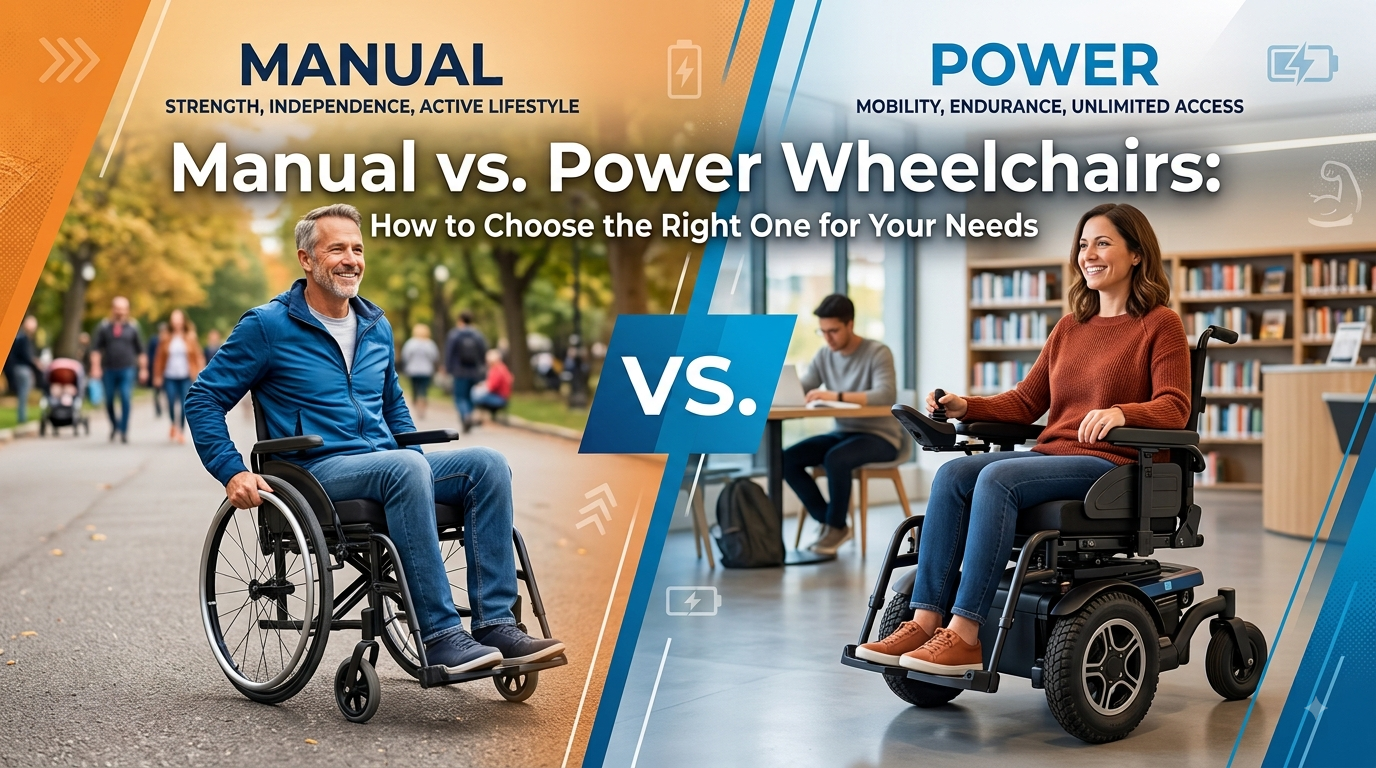
Choosing a wheelchair is rarely just about picking a piece of equipment — it's about choosing independence, comfort, and quality of life. Whether you're selecting a wheelchair for yourself, a family member, or a patient, one of the first and most important decisions you'll face is: manual or power wheelchair?
Both options offer mobility and freedom, but they serve very different needs. A manual wheelchair may be perfect for someone with strong upper body strength who values portability, while a power wheelchair might be essential for someone with limited stamina or dexterity. Making the wrong choice can lead to fatigue, frustration, or even injury — which is why understanding the differences matters so much.
In this guide, we'll break down everything you need to know about manual and power wheelchairs, including cost, functionality, lifestyle fit, and maintenance, so you can make a confident, informed decision.
What Is a Manual Wheelchair?
A manual wheelchair is a mobility device propelled by the user (self-propelled) or pushed by a caregiver (attendant-propelled). It typically consists of a lightweight frame, large rear wheels with hand rims, smaller front caster wheels, and a seating system.
Types of Manual Wheelchairs
Standard/Lightweight Wheelchairs – Budget-friendly, durable, and widely used in hospitals and care facilities.
Ultra-Lightweight Wheelchairs – Designed for active, independent users; often used by people with long-term mobility needs.
Transport Wheelchairs – Compact and designed to be pushed by a caregiver rather than self-propelled.
Sports/Active-Use Wheelchairs – Built for speed, agility, and adaptive sports.
Advantages of Manual Wheelchairs
Lightweight and portable — easy to fold, lift, and transport in a car
Lower cost compared to power wheelchairs
Low maintenance — fewer mechanical or electrical components to service
Promotes physical activity — self-propelling can support upper body strength and cardiovascular health
No charging required — always ready to use
Easier to navigate tight spaces like small bathrooms or narrow hallways
Disadvantages of Manual Wheelchairs
Requires significant upper body strength and stamina
Can cause shoulder, wrist, or arm strain over time with prolonged use
Less practical for long distances or uneven terrain
Attendant-propelled models require a caregiver to always be present
What Is a Power Wheelchair?
A power wheelchair (also called an electric wheelchair) uses a battery-powered motor and a joystick or alternative control system to move. It's designed for individuals who cannot self-propel a manual chair or who need to conserve energy for daily activities.
Types of Power Wheelchairs
Standard Power Wheelchairs – Ideal for indoor and light outdoor use
Heavy-Duty/Bariatric Power Wheelchairs – Built for higher weight capacities and added durability
All-Terrain Power Wheelchairs – Designed for outdoor use on grass, gravel, or uneven ground
Power Wheelchairs with Tilt/Recline – Provide pressure relief and postural support for users with complex medical needs
Advantages of Power Wheelchairs
Minimal physical effort — ideal for users with limited strength, stamina, or dexterity
Greater independence for individuals who cannot self-propel
Higher weight capacities available for bariatric needs
Advanced features like tilt-in-space, recline, and elevating leg rests for pressure relief and comfort
Better for long distances and extended periods of use outdoors
Disadvantages of Power Wheelchairs
Higher upfront cost and ongoing maintenance
Heavier and bulkier — harder to transport without a wheelchair-accessible vehicle or lift
Requires regular battery charging
More complex mechanically, meaning more potential for repairs
Less ideal for very tight indoor spaces, depending on chair size
Manual vs. Power Wheelchair: Side-by-Side Comparison
Key Factors to Consider When Choosing
1. Physical Strength and Stamina
If the user has strong upper body strength and no conditions that would be worsened by repetitive strain, a manual wheelchair can offer excellent independence and even health benefits. However, if fatigue, muscle weakness, or joint conditions like arthritis are a concern, a power wheelchair reduces physical strain significantly.
2. Lifestyle and Daily Activities
Think about how and where the wheelchair will be used most:
Frequent travel or car transport → Manual wheelchairs are easier to fold and store.
Long workdays or full-time use → Power wheelchairs reduce fatigue over extended periods.
Outdoor and uneven terrain → All-terrain power wheelchairs or active-use manual chairs perform best.
3. Living Environment
Small apartments or homes with narrow doorways may favor a compact manual wheelchair.
Homes with ramps, wide hallways, or accessible vehicles can better accommodate the size and weight of a power wheelchair.
4. Budget and Insurance Coverage
Power wheelchairs are a significantly larger investment, though insurance, Medicare, or Medicaid may cover part or all of the cost with proper documentation and medical necessity forms. Manual wheelchairs are generally more affordable out-of-pocket and easier to replace or upgrade.
5. Caregiver Availability
If a caregiver is consistently present and able to assist, an attendant-propelled manual wheelchair may be sufficient. If the goal is independence without relying on someone else for mobility, a power wheelchair is often the better fit.
6. Medical Condition and Prognosis
Progressive conditions (such as ALS, muscular dystrophy, or advanced multiple sclerosis) often make a power wheelchair the more practical long-term solution, even if a manual chair is sufficient in early stages. A conversation with a physical therapist or physician is essential to plan for future mobility needs, not just current ones.
Hybrid Solutions Worth Knowing About
For users who don't fit neatly into either category, there are a few hybrid and supplementary options:
Power-Assist Wheels – Add-on wheels that attach to a manual wheelchair frame, providing motorized assistance without the bulk of a full power chair.
Scooters – A lighter-weight alternative to power wheelchairs for users with good trunk control and stamina, though they offer less postural support.
Lightweight Power Wheelchairs – Newer models are being designed with more portable, foldable frames to bridge the gap between manual and traditional power chairs.
Why Your Wheelchair Supplier Matters as Much as the Wheelchair Itself
Choosing between manual and power is only half the equation — who you buy from can be just as important as what you buy. A knowledgeable wheelchair supplier does more than sell equipment; they assess your specific needs, help you navigate insurance and Medicare paperwork, ensure proper sizing and fitting, and stand behind the product with reliable after-sales service. A poorly fitted wheelchair, regardless of whether it's manual or power, can lead to pressure sores, poor posture, back pain, and reduced mobility rather than improved independence. Working with an experienced supplier who offers in-person fittings, trial periods, and access to certified rehab technology specialists can make the difference between a wheelchair that sits in a closet and one that genuinely improves daily life.
Beyond the initial purchase, a good supplier is a long-term partner in your mobility journey. Manual wheelchairs need periodic checks on tires, casters, and frame integrity, while power wheelchairs require ongoing battery maintenance, software updates, and motor servicing — all of which are far easier to manage with a supplier who offers local repair support, loaner chairs during service, and readily available replacement parts. This is especially important for care facilities and dealers purchasing in bulk, where downtime directly affects patient care. When evaluating suppliers, look for manufacturer warranties, transparent pricing, insurance billing assistance, and reviews or testimonials that speak to responsiveness after the sale — not just the quality of the initial transaction.
Final Thoughts: Making the Right Choice
There's no universal "better" option between manual and power wheelchairs — only the option that's better for the individual. The right choice depends on physical ability, lifestyle, environment, budget, and long-term medical needs.
The best approach is to consult with a physical or occupational therapist, try out different models when possible, and work with a knowledgeable wheelchair supplier who can guide you through sizing, features, and insurance documentation.
Looking for expert guidance on choosing the right wheelchair? Our team specializes in both manual and power wheelchair solutions tailored to your unique needs. Contact us today for a personalized consultation or to schedule a fitting with one of our mobility specialists.
Frequently Asked Questions
Can insurance cover both manual and power wheelchairs?
Yes, but coverage depends on medical necessity documentation from a physician and, often, an evaluation by a physical or occupational therapist. Power wheelchairs typically require more extensive documentation due to their higher cost.
Is a power wheelchair better for elderly users?
Not always. It depends on the individual's strength, cognitive ability to safely operate a joystick, and living environment. Many elderly users do very well with manual wheelchairs, especially attendant-propelled models.
Can I switch from a manual to a power wheelchair later?
Yes. Many users start with a manual wheelchair and transition to a power wheelchair as mobility needs change, particularly with progressive conditions.
How long do power wheelchair batteries last?
Most power wheelchair batteries last 8–20 miles per charge depending on the model, terrain, and user weight, and typically need replacing every 1–2 years with regular use.
What should I look for in a wheelchair supplier?
Look for a supplier that offers in-person fittings or virtual consultations, assistance with insurance and Medicare documentation, manufacturer-backed warranties, and reliable local repair or loaner-chair support. A supplier who treats the sale as the start of a relationship — not the end of one — will save you time and frustration down the road.
How often should a wheelchair be serviced or replaced? Manual wheelchairs typically benefit from a basic tune-up (tires, casters, bolts, upholstery) once or twice a year, while power wheelchairs generally need professional servicing at least annually to check batteries, motors, and electronics. Most wheelchairs, manual or power, are replaced every 3–5 years, though insurance replacement timelines vary by provider.